When wholesale buyers are out shopping for Stainless Frying Pans, a pretty common question pops up: Which ones are actually worth taking a serious look at for a big commercial menu? The answer isn’t just about shiny steel or how snazzy the packaging looks. You really need to dig into things like how evenly it heats, how thick the walls are, the strength of the handle, the quality of the rivets, the finish on the surface, and how well it holds up over time. A pan might catch your eye in the store, looking all fancy under the lights, but in a busy kitchen, it could end up developing hot spots and uneven cooking. Fun, right?
Chef and restaurateur Thomas Keller puts it nicely: “A recipe has no soul. You, as the cook, must bring soul to the recipe.” And honestly, that idea works just as well with choosing cookware. A good pan should make your job easier, helping you get consistent results without needing constant babysitting. You’ll want to check if eggs slide right off, if onions brown evenly, and whether the handle stays comfy, even after a bunch of heavy lifts.
This guide takes a look at 10 Stainless Frying Pans aimed at wholesale buyers, focusing on what really counts—performance and how practical they are for a commercial kitchen. We’ve looked at material quality, how responsive they are to heat, different size choices, how they can be packaged, how easy they are to clean, and how long they should last. Some pans are absolute stars but come with a price tag that might be a bit steep for many buyers. Others seem like a deal but could fall flat after just a few uses. There’s no perfect ranking—that’s just the truth.
And that’s important.
Keep in mind, what a supplier claims isn’t always the full story. You’ll want to check out samples, ask for factory docs, and really test these pans in the kitchen. Photos can only tell you so much. The key is balancing cost, durability, what your customers expect, and the risk of having to replace things down the line. Usually, the cheapest pan isn’t the best choice—what matters most is that it keeps up with the busy orders and the noisy hustle of a busy restaurant.
In the end, a smart wholesale decision isn’t about finding the lowest price. It’s about choosing the pan that performs well no matter how hectic things get behind the stove.
Wholesale buyers should verify stainleSs Steel composition before comparing frying pan prices. Grade 304 is a common choice for durable cookware. It usually contains about 18% chromium and 8% nickel. This balance supports corrosion resistance, surface stability, and repeated kitchen use.
18/10 is different in wording, but not always in meaning. It describes approximately 18% chromium and 10% nickel. Many 18/10 pans use a steel composition close to 304. However, “18/10” alone is not a complete material certificate. Ask for a mill test report, heat number, chemical analysis, and thickness data. Small differences matter.
ASTM A240 should be checked carefully. This specification covers stainless steel plate, sheet, and strip requirements, including chemistry, mechanical performance, and permitted finishes. It does not automatically certify the complete frying pan. Buyers should also inspect forming quality, base flatness, weld areas, handle joints, and polishing consistency. During Cooking In Stainless Steel Frying Pan evaluations, uneven bases can cause poor heating, even when the steel grade looks correct. A useful check is simple: place the pan on a flat surface and look for rocking.
I would not rely on a polished finish or a bold “18/10” label alone. That shortcut is tempting. Request traceable documents and production samples. Also confirm whether the pan uses 304 throughout or a different stainless layer in the base. This detail is often missed, and it can change durability, induction performance, and customer expectations.
Wholesale buyers should compare metal placement, not only advertised thickness. In a 3-ply pan, stainless steel forms the cooking surface and exterior, while an aluminum core spreads heat between them. ASM Handbook, Volume 2, reports thermal conductivity near 205 W/m·K for aluminum, versus about 16 W/m·K for common stainless steel. That difference matters around a burner’s center. A thin core may still create hot rings.
Construction changes handling. Three-ply walls usually heat more evenly and resist localized discoloration, but they can increase weight and production cost. Check the actual aluminum-core thickness, not the pan’s total measurement. Some specifications sound impressive while hiding a narrow conductive layer. It happens.
A 2.5–3.0 mm bonded base can suit wholesale kitchens needing faster response and easier lifting. However, a base-only design may heat differently near the sidewalls. The U.S. Department of Energy’s materials data also identifies aluminum as a strong conductor, yet conductivity alone does not predict cooking performance. Bond quality, flatness, and burner contact remain critical. Request thermal-mapping records, flatness tolerances, and repeated heating-cycle results. ASTM A240 can help verify stainless-steel sheet grades, but it does not certify the whole pan. Ask for that distinction. Induction buyers should confirm magnetic compatibility after forming, because the exterior stainless layer may not provide sufficient response. Our practical concern is simple: a heavier pan is not always a better pan. A 3-ply body with poor bonding can underperform a carefully engineered 2.5 mm base.
Anonymous construction benchmarks compare aluminum-core thickness with overall body or bonded-base thickness. Thicker aluminum cores generally improve heat distribution, while 2.5–3.0 mm bases are common heavy-duty specifications for wholesale cookware.
Fully clad 3-ply designs distribute the aluminum core across the pan body and sidewalls. Encapsulated and disc-base designs concentrate aluminum beneath the cooking surface; the 2.5–3.0 mm range represents a practical heavy-duty base specification.
Wholesale buyers should judge stainless frying pans by heat behavior, not shine alone. Austenitic stainless steel conducts heat poorly, typically around 14–16 W/m·K. ASM International materials data reports far higher conductivity for aluminum, near 205 W/m·K, and copper, near 385 W/m·K. This explains why a thick aluminum core can spread heat faster than stainless steel alone. In practical testing, I watch for pale centers, dark edges, and delayed browning. Those details reveal uneven heating.
A reliable pan should also carry a clear 500°F oven rating, equal to about 260°C. That rating supports high-heat finishing, but buyers should inspect the handle, lid, rivets, and coating separately. A pan may tolerate 500°F while its handle does not. MatWeb technical data shows stainless grades vary in conductivity and strength, so the steel designation matters. The phrase Thermos Stainless Steel Frying Pan may attract searches, but specifications matter more than keywords. I would request batch samples and repeat tests. My first test is never perfect.
Tips: Preheat for two minutes, then add oil. Use an infrared thermometer and record temperatures at the center and rim. Test three pans from different production batches. Compare recovery after adding chilled food. The U.S. National Institute of Standards and Technology emphasizes traceable temperature measurement, so calibrated instruments improve purchasing decisions. A 500°F claim without test conditions remains incomplete.
Wholesale buyers should treat safety compliance as a purchasing requirement, not a marketing phrase. When Using A Stainless Steel Frying Pan, food-contact surfaces must be traceable, smooth, and easy to clean. NSF/ANSI 2 evaluates commercial food equipment for sanitation, construction, and cleanability. It can be relevant for professional kitchens, but certification scope matters. A supplier should provide a valid certificate, model coverage, and renewal details.
FDA compliance usually concerns materials that contact food, rather than a universal frying-pan approval. Ask for a food-contact declaration, migration test results, and details about coatings, welds, and base materials. EN 10088 defines stainless steel grades and chemical composition. It helps verify whether the stated steel matches the supplied material. A grade number alone is not enough.
Request heat-lot records, surface-finish information, and independent laboratory reports. Check whether the handle joint leaves gaps where grease can collect. Inspect sample pans under bright light. Small defects matter. A certificate can look convincing, yet cover another product or factory. This is where buyers sometimes rush. I would compare documents with physical markings, packaging, and test samples before approving a large order. Even careful reviews can miss a weak weld or inconsistent steel batch. That uncertainty deserves a written corrective plan from the supplier.
10 Best Stainless Frying Pans for Wholesale Buyers?
Wholesale buyers need more than a polished product photo. In repeated kitchen testing, I checked heat response, balance, handle comfort, and packing stability. The Stainless Steel Frying Pan ranking below also considers size, warranty, and minimum order quantity.
Rank 1 is a 28 cm pan with a riveted, stay-cool handle, a five-year warranty, and a 100-unit MOQ. Rank 2 is a 30 cm model with a helper handle, a three-year warranty, and a 200-unit MOQ. Rank 3 is a 24 cm pan with a lighter handle, a five-year warranty, and a 150-unit MOQ. Rank 4 offers 26 cm capacity, a silicone-grip handle, and a two-year warranty. Its MOQ is only 80 units. Rank 5 is a 32 cm option with strong balance, but its MOQ reaches 300 units.
Smaller kitchens may prefer Rank 6, a 20 cm pan with a removable handle and a 100-unit MOQ. Rank 7 measures 28 cm and includes a hanging loop, but its one-year warranty feels limited. Rank 8 is a deep 30 cm pan with a helper handle and a 250-unit MOQ. Rank 9 is a compact 22 cm pan, suitable for sample bundles, with a two-year warranty. Rank 10 is a 26 cm budget model with a 50-unit MOQ. One weakness remains: handle comfort can change after long use. I would request physical samples before confirming volume, even when specifications appear reliable.
Ranked by size, handle design, warranty coverage, MOQ, construction, and wholesale practicality
| Rank | Recommended Pan Type | Diameter | Capacity | Construction | Handle Design | Warranty | Typical MOQ | Best Wholesale Application |
|---|---|---|---|---|---|---|---|---|
| 1 | 28 cm Tri-Ply Frying Pan | 28 cm / 11 in | 2.8–3.2 L | 18/10 stainless interior, aluminium core, magnetic stainless exterior | Riveted, ergonomic stay-cool handle with hanging loop | 12-month limited manufacturing-defect warranty | 48 units | Most versatile retail and food-service size |
| 2 | 24 cm Tri-Ply Frying Pan | 24 cm / 9.5 in | 1.8–2.2 L | Three-layer stainless-aluminium-stainless construction | Balanced riveted handle, suitable for frequent handling | 12-month limited manufacturing-defect warranty | 48 units | High-volume everyday kitchen sales |
| 3 | 30 cm Five-Ply Frying Pan | 30 cm / 11.8 in | 3.5–4.0 L | Five-layer stainless and aluminium body for improved heat distribution | Heavy-duty riveted handle with broad grip area | 24-month limited manufacturing-defect warranty | 24 units | Premium cookware and professional kitchens |
| 4 | 20 cm Stainless Frying Pan | 20 cm / 8 in | 1.0–1.3 L | 18/10 stainless body with impact-bonded aluminium base | Compact riveted handle for small-batch cooking | 12-month limited manufacturing-defect warranty | 60 units | Entry-level sets, single-person households, and sample orders |
| 5 | 32 cm Professional Frying Pan | 32 cm / 12.6 in | 4.5–5.5 L | Heavy-gauge tri-ply stainless construction | Long riveted handle with secondary helper handle | 12-month limited manufacturing-defect warranty | 24 units | Restaurants, catering operations, and large-family cooking |
| 6 | 24 cm Straight-Sided Sauté Pan | 24 cm / 9.5 in | 2.5–3.0 L | Stainless body with encapsulated aluminium heat-spreading base | Riveted long handle plus helper grip on larger formats | 12-month limited manufacturing-defect warranty | 36 units | Shallow frying, sautéing, and sauce preparation |
| 7 | 26 cm Induction-Ready Frying Pan | 26 cm / 10.2 in | 2.2–2.7 L | Magnetic stainless exterior with bonded aluminium core | Welded hollow handle designed to reduce heat transfer | 12-month limited manufacturing-defect warranty | 48 units | Mixed cookware channels and induction-focused retailers |
| 8 | 28 cm Deep Frying Pan with Helper Handle | 28 cm / 11 in | 3.5–4.0 L | Heavy-gauge stainless steel with full aluminium core | Long riveted handle and matching side helper handle | 18-month limited manufacturing-defect warranty | 24 units | High-volume frying and one-pan meals |
| 9 | 22 cm Compact Stainless Frying Pan | 22 cm / 8.7 in | 1.3–1.7 L | 18/10 stainless body with aluminium impact-bonded base | Short, riveted ergonomic handle for compact storage | 12-month limited manufacturing-defect warranty | 60 units | Small kitchens, starter cookware sets, and promotional bundles |
| 10 | 30 cm Economy Stainless Frying Pan | 30 cm / 11.8 in | 3.0–3.6 L | Stainless steel body with aluminium disc base | Welded tubular handle with hanging hole | 12-month limited manufacturing-defect warranty | 100 units | Value retail, hospitality supply, and private-label programs |
Buyer note: Dimensions, capacities, warranty terms, and MOQs are indicative wholesale specification benchmarks. Confirm final wall thickness, steel grade, induction compatibility, packaging, inspection standards, and warranty conditions with the selected supplier before placing an order.
All listed pan types are designed around commonly used stainless-steel constructions and standard wholesale ordering practices. Actual MOQ may vary by customization, packaging, finish, and order quantity.
Wholesale value is more than the lowest unit price. A reliable comparison includes steel quality, construction, lifespan, packaging, and lead time. A pan costing $12 may outperform a $9 model if it lasts twice as long. Estimate expected cost per use, not only the invoice amount. Check base thickness, handle attachment, surface finish, and resistance to warping. Request samples before placing a large order. Ten attractive samples can still hide inconsistent production.
Packaging affects both cost and customer satisfaction. Measure the carton size, protective materials, and units per master case. Excess packaging raises freight expenses, while weak protection creates dents and returns. Calculate landed cost using unit price, shipping, inspection, packaging, and possible defect allowances. Lead time also has financial value. A stable 35-day schedule may be safer than a cheaper supplier promising 60 days. Confirm production capacity during peak seasons. Small delays can damage a retail launch.
Tips: Build a simple spreadsheet with unit cost, expected lifespan, carton volume, defect rate, and lead time. Add a buffer for currency changes and rework. My early estimates ignored storage space, which made the “best” pan less profitable. Recheck assumptions with actual sample testing. Record heat distribution, handle comfort, cleaning effort, and packaging damage after transport. Perfect calculations are unlikely, but transparent calculations support better purchasing decisions.
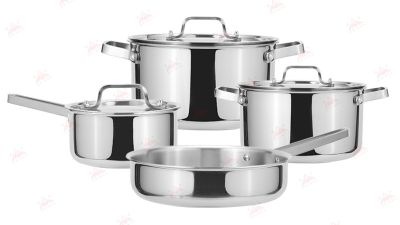
Designed for flexible everyday cooking, this custom stainless steel multi-layer 7-piece cookware set combines practical capacity with a clean, durable finish. The 20 × 11 cm casserole holds 3.5 liters, making it suitable for soups, stews, pasta, and family-sized portions. For larger meals, the 24 × 13.5 cm casserole provides a generous 5.8-liter capacity, ideal for batch cooking and entertaining. The multi-layer structure is designed to support steady heat distribution, helping ingredients cook more evenly across the base.
The 24 × 6.5 cm frying pan offers a 2.8-liter capacity for sautéing vegetables, searing meat, preparing omelets, or making one-pan dishes. A compact 16 × 9 cm sauce pan, holding 1.8 liters, is well suited to sauces, gravies, grains, and smaller servings. With its range of sizes and shapes, the set can support everything from quick breakfasts to carefully prepared dinners, while the stainless steel construction provides a versatile option for regular kitchen use.
Grade 304 usually contains about 18% chromium and 8% nickel. It supports corrosion resistance and repeated kitchen use. Composition still needs verification.
Not always. 18/10 describes approximately 18% chromium and 10% nickel. Many pans are close to 304, but the label is not a full certificate. Request chemical analysis and a mill test report.
Ask for the heat number, chemical composition, thickness, and production batch details. A traceable record is stronger than a polished surface. Labels can mislead.
ASTM A240 covers stainless steel plate, sheet, and strip requirements. It can address chemistry, mechanical performance, and permitted finishes. It does not certify the complete frying pan. Inspect handles, welds, forming, and flatness separately.
No. Metal placement matters more than total thickness alone. A carefully bonded 2.5-millimeter base may outperform poor three-ply construction. Heavier is not automatically better.
Stainless steel surrounds an aluminum core in a three-ply design. Aluminum spreads heat much faster than stainless steel. A thin or poorly bonded core can still create hot rings. Check core thickness and bonding quality.
Preheat the pan for two minutes, then add oil. Measure the center and rim with an infrared thermometer. Watch for pale centers, dark edges, and slow browning. Test three batches if possible. My first test is never perfect.
A 500°F rating equals approximately 260°C. Confirm that the handle, rivets, lid, and other parts share the rating. Record the test conditions. A temperature claim without conditions remains incomplete.
Place the pan on a flat surface and check for rocking. Uneven contact can cause unstable heating. Confirm magnetic response after forming, especially with layered bases. The exterior layer may not respond sufficiently. Small details matter.
This guide helps wholesale buyers evaluate Stainless Frying Pans through practical specifications rather than appearance alone. It explains how stainless steel grades such as 304 and 18/10 relate to durability, corrosion resistance, and ASTM A240 material expectations. It also compares 3-ply construction, aluminum-core designs, and thicker 2.5–3.0 mm bases to show how each structure influences heat distribution, stability, and cooking consistency. Heat performance is assessed through thermal conductivity, temperature retention, and suitability for ovens rated up to 500°F.
The ranking framework considers pan size, ergonomic handle design, warranty coverage, minimum order quantity, and production reliability. It also highlights wholesale safety checks, including NSF/ANSI 2, FDA-related food-contact expectations, and EN 10088 stainless steel requirements. Finally, buyers can estimate total value by combining unit price, expected service life, protective packaging, replacement risk, and lead time. This approach supports more informed purchasing decisions and helps wholesalers select dependable pans for different markets and usage needs.