




Spin Body vs. Press Body: Which Cookware Forming Process is Right for Your Brand?
In cookware manufacturing, the forming process dictates not only the physical characteristics of the final product—such as heat distribution and weight—but also critical business metrics including tooling costs, lead times, and Minimum Order Quantities (MOQs).
When developing a new line of Stainless Steel or aluminum cookware, brand owners and industrial designers must choose between the two primary forming methods: Deep Drawing (Press Body) and Metal Spinning (Spin Body).
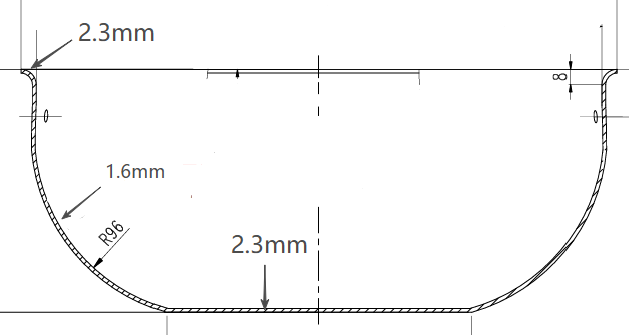 | 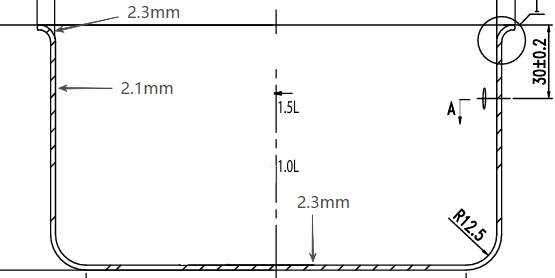 |
Wall thickness comparison between press body and spin body cookware
This guide provides an objective technical and commercial comparison to help you determine the optimal manufacturing process for your next cookware project.
1. What is Metal Spinning (Spin Body)?
Metal spinning is a cold-forming process where a metal disc is fixed to a rotating lathe. A roller then applies pressure from the center outward, forcing the metal to flow and conform to the shape of a mandrel. Today, this is often executed using CNC (Computer Numerical Control) machines.
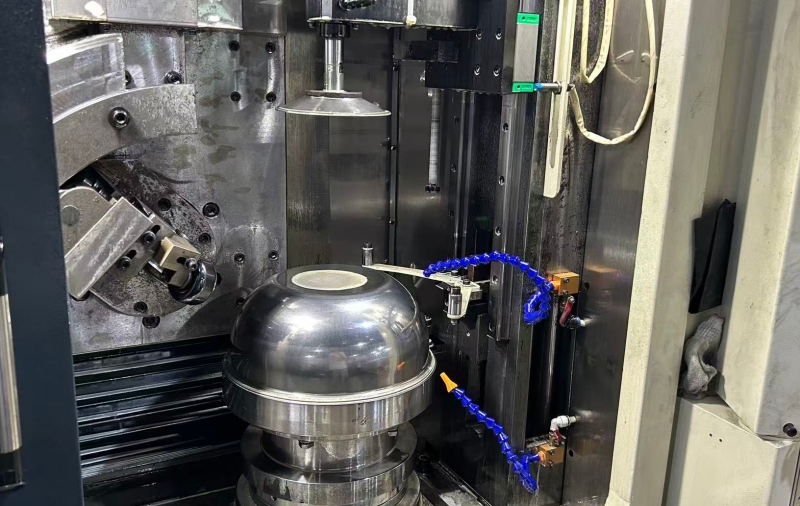
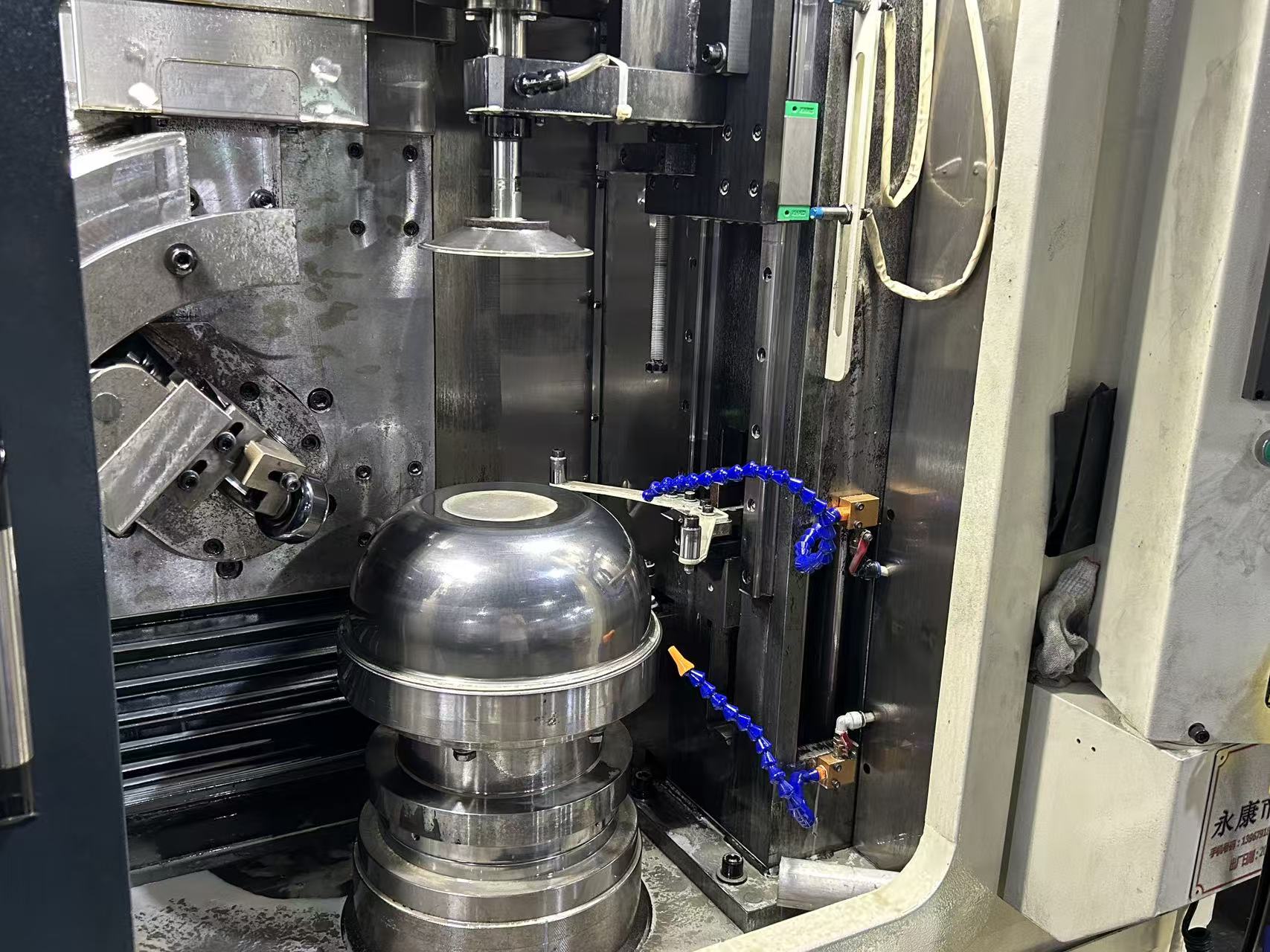
CNC metal spinning machine for stainless Steel Cookware manufacturing
Pros of Spin Body:
Variable Wall Thickness (Thermal Control): Spinning allows manufacturers to dictate material flow, creating a "thick bottom, thin wall, and thick rim" profile. This ensures excellent heat retention at the base and prevents rim deformation, making it highly suitable for mid-to-high-end tri-ply or clad steel cookware.
Material Savings and Cost Reduction: By intentionally thinning the cookware walls, spinning significantly reduces the total amount of raw material required per unit. This lowers both the material cost and the overall weight of the product.
High Material Utilization: The spinning process generates very little edge scrap, ensuring a highly efficient use of raw materials.
Low Tooling Costs: Spinning mandrels are much simpler and cheaper to produce than deep drawing dies, lowering the barrier to entry for new projects.
Cons of Spin Body:
Limited Capacity and Technological Maturity: Currently, highly automated spinning for certain complex cookware profiles is still in a trial-production or scaling phase across the industry. The technology's maturity is still developing, meaning total production capacity is capped compared to established pressing lines.
Slower Cycle Times: Forming a single piece on a spinning lathe takes considerably more time than a single stroke of a hydraulic press.
Shape Limitations: Spinning is strictly limited to manufacturing concentric, cylindrically symmetrical items (i.e., perfectly round pots and pans).
2. What is Deep Drawing (Press Body)?
Deep drawing, commonly referred to as "press body," is a metal forming process where a flat sheet metal blank is drawn into a forming die under extreme pressure using a hydraulic press.

Pressing machine for stainless steel cookware manufacturing
Pros of Press Body:
Maximum Production Efficiency: Once tooling is set up, hydraulic presses operate at high speeds, making this process highly optimized for mass production and automated assembly lines.
High Consistency: The mechanical nature of the press ensures exact dimensional tolerances and extreme consistency across thousands of units.
Shape Versatility: Unlike spinning, deep drawing is not limited to round designs. It is capable of producing square grill pans, oval roasters, and other asymmetrical cookware shapes.
Cons of Press Body:
High Tooling Costs and Long Lead Times: Engineering and manufacturing the hardened steel dies required for deep drawing is an expensive and time-consuming upfront investment.
Uniform Wall Thickness: The pressing process generally results in a uniform thickness across the bottom and the walls of the cookware. Without specialized (and costly) progressive stamping, it cannot achieve the "thick bottom, thin wall" structure favored in certain thermal designs.
3. How to Choose the Right Process for Your Project
Choosing between Press Body and Spin Body requires balancing your cost targets with your product positioning.
Scenario A: When to Choose Press Body (Deep Drawing)
Massive Order Volumes: You are supplying large retail chains or supermarkets where massive scale and rapid delivery are required.
Non-Standard Shapes: Your cookware design includes square, oval, or strictly rectangular profiles.
High Price Sensitivity: You require the absolute lowest processing cost at scale, and your product design does not require variable wall thickness.
Scenario B: When to Choose Spin Body (Metal Spinning)
Cost Control and Weight Reduction: You want to reduce the product's overall weight to save on raw material and shipping costs without sacrificing bottom heat retention.
Mid-to-High-End Positioning: Your brand focuses on thermal performance, requiring specific wall-to-base thickness ratios.
Market Testing (New Brands): You are placing a smaller initial order to test market viability and wish to avoid heavy upfront tooling fees.
Rapid Prototyping: Your project requires high customization and fast, iterative prototype development.
Market Outlook: The Next 2-3 Years
Historically, deep drawing dominated the cookware industry due to its sheer output volume. However, the manufacturing landscape is shifting. Over the next 2 to 3 years, CNC Metal Spinning is projected to capture a significantly larger market share due to several converging factors:
Capacity and Technology Upgrades: The traditional bottleneck of spinning—slow production speed—is being eliminated. The latest multi-roller CNC spinning machines, integrated with robotic loading/unloading arms, have drastically reduced cycle times, closing the efficiency gap with hydraulic presses.
Structural Shift in Consumer Demand: Global consumers are upgrading from basic non-stick aluminum to durable, high-performance multi-clad stainless steel cookware. Spinning is inherently better suited to maximize the thermal dynamics of clad metals.
Agile B2B Procurement: To mitigate inventory risks, modern brands are shifting away from massive annual orders toward "low-volume, high-frequency" purchasing models. The low tooling cost and quick setup of spinning lines perfectly accommodate this agile supply chain strategy.
While pressing will remain the standard for basic, high-volume commodities, CNC spinning is rapidly becoming the standard for performance-driven cookware brands.
Conclusion
Neither process is universally superior; the right choice depends entirely on your unit economics, design geometry, and market positioning. Deep drawing offers unmatched scale for uniform geometries, while metal spinning provides the thermal engineering and supply chain agility required for premium cookware.
Are you developing a new cookware line? Our engineering team can analyze your 3D drawings to recommend the most cost-effective and performance-enhancing forming process. Contact us today for a technical review and quotation.